Cost of Living & Taxes in Russia 2026: What Expats Need to Know

CTO, Relocate Russia · 19 min read
By 2026, the architecture of the global economy and cross-border capital mobility has undergone fundamental changes. The institutional environment of the Russian Federation, adapting to the conditions of structural transformation, has formed an entirely new financial, tax and macroeconomic reality. For international corporations planning to relocate employees, as well as for highly qualified specialists (HQS) and independent expatriates, this reality requires deep rethinking.
Executive Summary: Financial Planning for Russian Relocation (2026–2027)
- Fiscal policy: the newly implemented progressive tax scale (effective 2025) taxes personal income at marginal rates spanning from 13% to 22%.
- Utility expenditure: state-subsidised energy prices keep overhead costs significantly below the European average — approximately $50–$90 per month for a standard metropolitan residence.
- Real estate: premium rental markets in Moscow and St. Petersburg offer highly competitive rates per square metre compared with major Western hubs.
- Purchasing power: high local purchasing power is sustained by localised agricultural and manufacturing supply chains, mitigating inflation on essential goods.

This analytical report is a comprehensive expert breakdown of the practical economy for expats in Russia. The main goal of this study is the systematic removal of technical and financial barriers through a detailed explanation of the mechanisms of fiscal burden, the structure of everyday expenses and the pricing of basic goods. The focus is on the new progressive personal income tax scale introduced in 2025, the fundamental comparison of European and Russian bills for electricity, gas and heating, as well as a deep analysis of imbalances in the residential rental market.
Macroeconomic context of 2026
The Russian economy operates under unprecedentedly tight monetary policy. The Bank of Russia maintains the key rate at 15.5%, which is a direct response to the inflationary pressure generated by large-scale fiscal impulses and the growth of industries servicing government contracts. While public sector industries demonstrate rapid growth, the civilian economy faces stagnation due to the high cost of credit resources.
Paradoxically, tight monetary policy and strict currency control have led to a significant strengthening of the national currency. In the second quarter of 2026, the Russian ruble demonstrated outstanding dynamics, becoming one of the strongest currencies in the world against the US dollar, reaching approximately 72.6 rubles per dollar. This exchange rate stability, supported by a trade balance surplus and high revenues from energy exports, forms a solid foundation for assessing real purchasing power.
Evolution of the fiscal paradigm: the Russian progressive tax
For almost two decades, starting in 2004, the Russian Federation attracted foreign capital, entrepreneurs and highly qualified personnel largely thanks to its tax system. The flat personal income tax (PIT) rate of 13% was the cornerstone of Russian economic liberalism, ensuring high tax collection and extreme simplicity of administration.
However, the growth of budget expenditures, the need to redistribute national wealth and the demand for social justice led to a radical reform. The law signed in 2024, which fully came into force on January 1, 2025, completely changed the landscape of personal income taxation, introducing a multi-stage model that defines financial planning in 2026.
The mechanics of marginal taxation in 2026
The new PIT architecture is a five-step progressive scale. A critically important technical nuance, often overlooked in superficial analysis, is the principle of marginal (cumulative) calculation. The taxpayer does not pay the increased rate on the entire amount of earned funds when moving into a new category; the increased rate is applied exclusively to the part of income that exceeds the established threshold.
| Annual aggregate income (RUB) | PIT rate on marginal portion | Tax calculation algorithm (cumulative) |
|---|---|---|
| Up to 2.4 million | 13% | 13% of the actual income amount |
| From 2.4 million to 5 million | 15% | 312,000 RUB + 15% on the amount exceeding 2.4 million |
| From 5 million to 20 million | 18% | 702,000 RUB + 18% on the amount exceeding 5 million |
| From 20 million to 50 million | 20% | 3,402,000 RUB + 20% on the amount exceeding 20 million |
| Over 50 million | 22% | 9,402,000 RUB + 22% on the amount exceeding 50 million |
Analytics based on regulatory data from the Ministry of Finance and the Federal Tax Service of the Russian Federation, current for 2025–2026.
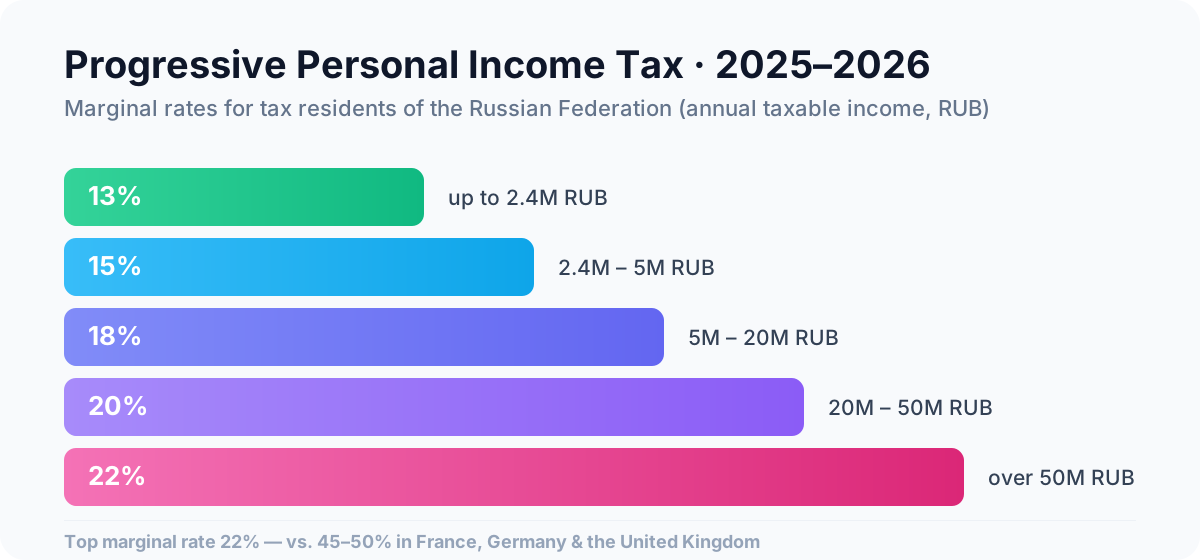
At an exchange rate of 72.6 rubles per US dollar, the base threshold of 2.4 million rubles (up to which the familiar 13% rate applies) is equivalent to approximately $33,050 per year (or about $2,750 per month). This means that for line personnel and entry-level specialists the tax burden has not changed. However, highly qualified specialists, engineers, project managers and top managers, whose income regularly exceeds the equivalent of $70,000–$100,000 per year, inevitably fall into the 15% and 18% brackets. Persons with super-incomes exceeding 50 million rubles per year (about $688,000) are taxed at the maximum marginal rate of 22%.
Calculation example: effective rate below marginal
If a top manager earns 10 million rubles per year, his effective (real) tax rate will not be 18%. He will pay 702,000 rubles on the first 5 million, and then 18% on the remaining 5 million (900,000 rubles). The total tax will be 1,602,000 rubles, which corresponds to an effective tax rate of exactly 16.02%. This example clearly shows that even with a progressive scale, Russian tax rates remain extremely attractive for capital accumulation.
Tax residency and expat status: the 2026 revolution
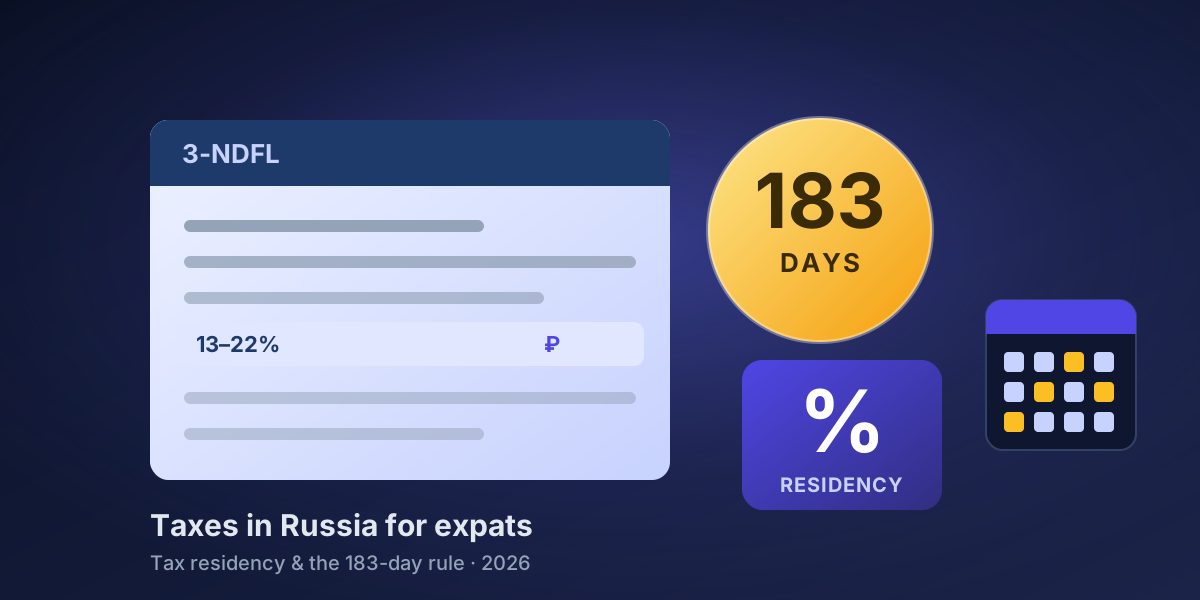
Historically, one of the main financial and psychological barriers for foreign specialists relocating to Russia was the mechanism of taxation of non-residents. In accordance with paragraph 2 of article 207 of the Tax Code of the Russian Federation, non-residents are persons who actually stay on the territory of the Russian Federation for less than 183 calendar days within 12 consecutive months. Until recently, non-residents were required to pay a penal flat rate of 30% on all types of income received from sources in Russia.
Removing barriers for non-resident employment income
In 2026, an unprecedented benefit has been introduced for foreign citizens who are not tax residents of the Russian Federation but carry out labor activities. For employees working under employment contracts (including remote workers, highly qualified specialists — HQS, as well as citizens of EAEU member states: Armenia, Belarus, Kazakhstan and Kyrgyzstan), the same preferential progressive scale from 13% to 22% applies as for Russian citizens. Citizens of EAEU countries get the right to apply this scale from the first day of work based on Article 73 of the EAEU Treaty.
For an expat this means the removal of a key financial barrier. There is no longer any need to lose 30% of income during the first six months of stay in the country. The levels of taxation of employment income for non-residents in 2026 are completely identical to those for residents. Moreover, regardless of the tax residency of the contractor, if a foreign specialist provides services under civil law contracts, the customer also withholds income tax on a progressive 13–22% scale.
Risk zones: passive income and foreign agent status
Despite the liberalization of taxation of employment income, the 2026 legislation maintains strict barrier measures for other types of enrichment of non-residents. For other income not related to employment activities (income from renting real estate, sale of property or sale of securities), the base flat rate of 30% is maintained. The only exception is dividends from Russian organizations — they are taxed at a fixed rate of 15%.
Expats and their corporate lawyers should pay particular attention to the status of foreign agents, which in 2026 acquired the status of a tough fiscal barrier. For persons officially included by the Ministry of Justice in the register of foreign agents, from January 1, 2026, a special punitive tariff applies: a flat rate of 30% on all types of income without exception. For such non-residents, any benefits regarding the period of property ownership and investment tax deductions are completely canceled.
Warning: foreign agent status
Inclusion in the foreign agent register makes any economic activity in Russia inexpedient — all income is taxed at the rate of 30%, and tax deductions and benefits for the period of property ownership are completely canceled.
The administration of these processes is entrusted to employers acting as tax agents. They are obliged to check the tax status of the employee on each date of payment of income. If during the calendar year an expat crosses the 183-day threshold and becomes a tax resident of the Russian Federation, the employer recalculates the tax. However, since the rates for employment income are now identical, this recalculation matters primarily for the application of tax deductions, since non-residents are completely deprived of the right to standard, social and property deductions.
Russia against the European fiscal landscape
A deep understanding of Russia tax rates 2026 is impossible without international benchmarking. Even taking into account the introduction of the 22% maximum marginal rate, the tax burden on human capital in Russia remains structurally lower than in most developed economies. In Norway, which is often considered the benchmark of a welfare state, the overall marginal personal income tax rate in 2026 reaches 39.7% (consisting of 22% general income tax and 17.7% top-bracket surtax). In the UK, Germany and France, marginal rates for high-paid specialists historically exceed 40–45%.
Against this background, an effective tax rate of 15–18% for a highly qualified expat in Moscow looks like a substantial financial incentive that allows maximizing net disposable income (Net-to-Gross ratio). This institutional advantage partly compensates for the geopolitical and logistical costs of relocation, acting as a powerful magnet for narrowly specialized professionals from Asia, the Middle East and pragmatic specialists from Europe.
As an engineering consultant relocating our operations from Düsseldorf to Moscow in late 2024, the primary concern was operational and personal overhead. The recalibration of our financial models was eye-opening. Despite the introduction of the new tax brackets, our net disposable income increased by nearly 35%, driven predominantly by the drastic reduction in premium housing costs and municipal utilities.
— Dr. Heinrich M., Managing Partner, relocated in 2024
The practical economy of housing: cost of living in Russia vs Europe
While in the field of taxation Russia demonstrates attractive conditions for expats, the real estate market in 2026 is a zone of colossal structural imbalances that requires careful navigation. The analysis reveals a paradoxical situation: buying housing has become economically irrational, while the long-term rental market offers an unsurpassed price-to-quality ratio by international standards.
The mortgage trap and the triumph of the rental market
The Bank of Russia key rate at 15.5% has radically transformed the real estate market. In the absence of preferential government programs unavailable to foreign citizens, market mortgage rates have acquired a prohibitive character. According to the global Numbeo database, the average annual fixed rate on a 20-year mortgage in Moscow and St. Petersburg in 2026 is 20.31% and 20.28% respectively.
At such a cost of borrowed capital, the Price to Income Ratio in Moscow reaches an alarming value of 20.67, and monthly market mortgage payments for a typical apartment absorb an unthinkable 427.41% of the average net salary. In St. Petersburg the situation is only slightly better: the price-to-income ratio is 14.64, and the mortgage burden is 302.24% of the average income.
These extreme metrics have led to a fundamental distortion of classical investment models. The Price to Rent Ratio in central Moscow has reached 30.76, which indicates extreme overvaluation of the asset itself relative to the cash flow it generates. As a result, the Gross Rental Yield for a rentier investor in the center of the capital is a microscopic 3.25% per year.
For an expatriate, this macroeconomic imbalance means one thing only: acquiring real estate in Russia is financially meaningless, but long-term renting provides exceptional opportunities for cost-of-living arbitrage. Apartment owners cannot pass their capital costs on to tenants due to limited purchasing power of the population, which artificially holds rental rates at a low level relative to the cost of the square meters themselves.
Comparative analysis of rental rates: Moscow, St. Petersburg and Europe
In 2026, Moscow retains the status of a premium location, absorbing the main financial flows. Nevertheless, in hard-currency terms the cost of rent remains competitive in the European context. Let's consider median rental rates in key cities (based on Numbeo data for May 2026).
| City / Location | 1-bedroom (center) | 1-bedroom (outside) | 3-bedroom (center) | 3-bedroom (outside) |
|---|---|---|---|---|
| Moscow, Russia | 118,026 RUB (~$1,625) | 63,255 RUB (~$870) | 244,482 RUB (~$3,367) | 116,718 RUB (~$1,607) |
| St. Petersburg, Russia | 66,413 RUB (~$914) | 39,419 RUB (~$543) | 128,947 RUB (~$1,776) | 79,000 RUB (~$1,088) |
| Berlin, Germany | €1,313 (~$1,430) | €926 (~$1,010) | €2,397 (~$2,612) | €1,764 (~$1,922) |
| Belgrade, Serbia | 87,125 RSD (~$806) | 59,251 RSD (~$548) | 162,665 RSD (~$1,506) | 108,473 RSD (~$1,004) |
The USD equivalent (at an indicative rate of 72.6 RUB/$ and cross-rates) is provided to ensure data comparability.
Renting a premium three-bedroom apartment in central Moscow (about $3,367) costs significantly more than similar housing in Berlin (about $2,612). This reflects the acute shortage of high-quality institutional housing of large area in the Central Administrative District of Moscow and the high concentration of corporate top managers whose relocation budgets cover such expenses. However, one-bedroom apartments in Moscow's residential districts ($870) are already cheaper than Berlin ones ($1,010).
A real find for remote workers and digital nomads is St. Petersburg. Renting housing there is on average 40–50% cheaper than in Moscow. Rates in the historical center of St. Petersburg are comparable to those in Belgrade, which has become a popular hub for expats in recent years. Mathematical modeling shows that to maintain an equivalent standard of living (including rent), which in Moscow requires an income of 390,000 rubles, in St. Petersburg it is enough to have about 288,676 rubles.
As for other everyday expenses (food, restaurants, transport, leisure), Russia offers a colossal discount compared to Western megacities. The Numbeo cost-of-living index records that St. Petersburg is 54.6% cheaper than New York (excluding rent), and rent in St. Petersburg is lower than New York rent by a stunning 79.4%. The average monthly cost of living for one person (excluding housing rent) in Russia is about $1,014.
The energy paradox: the secret of low energy prices in Russia
While tax regimes can be optimized and the value of real estate is dictated by market cycles, the utility sector demonstrates the most striking, institutionally entrenched contrast between Russia and the European Union. The phenomenon of energy prices in Russia is the cornerstone of the attractiveness of the cost of living for expats. The gap in tariffs for electricity and gas reaches multiple sizes, which fundamentally changes the structure of monthly household expenses.
The structure of European energy bills: the burden of decarbonization
According to Eurostat, an average EU household (with annual consumption of 2,500–4,999 kWh) paid about €1,400 for electricity in 2025, with prices continuing to rise in the first half of 2026, bringing the average bill close to €1,500. In Germany the average retail tariff reached 39.6 cents (about €0.396) per kWh. In the UK, British households on average pay about £1,580 per year.
The fundamental reason for the expensiveness of European energy lies in the pricing structure. The base cost of generation is only a small part of the bill. The European consumer pays huge non-energy costs: grid fees, taxes and environmental levies. A similar situation is observed with natural gas — in the first half of 2026, the average price of gas for household consumers in the EU was €12.28 per 100 kWh (about €0.1228 per kWh).
The mechanics of Russian utility tariffs
In the Russian Federation, the cost of energy resources for the population is protected from the volatility of world markets by a complex system of cross-subsidization and state damping. In 2025–2026, the average price of electricity in Russia was only 5.38 rubles per 1 kWh. In the capital region, traditionally the most expensive in the country, tariffs are strictly differentiated depending on the infrastructure of the building and the time of day.
Electricity tariff grid in Moscow (2025–2026):
| Tariff scheme | Homes with electric stoves and electric heating (RUB/kWh) | Homes with gas stoves (RUB/kWh) |
|---|---|---|
| Single-rate tariff | 6.88 (up to 8.46 in some New Moscow zones) | 8.00 |
| Two-rate (Day / Night) | 8.26 / 3.57 (up to 10.11 / 4.61) | 9.61 / 4.15 |
| Three-rate (Peak / Semi-peak / Night) | 9.83 / 6.88 / 3.57 (up to 11.77 / 8.46 / 4.61) | 11.43 / 8.00 / 4.15 |
Tariff analysis by the Department of Economic Policy and Development of the City of Moscow.
Converted into hard currency, the maximum base tariff in Moscow (8.00 rubles) is about US$0.11 (about €0.10) per kWh. The night tariff in homes with electric stoves drops to the equivalent of 5 cents. This is 3–4 times cheaper than in Germany or the UK.
The situation with natural gas is even more telling. The presence of a colossal domestic resource base allows gas to be sold to the population at symbolic prices. In the Moscow region in 2025–2026, the gas tariff for cooking and water heating is from 8.56 to 9.71 rubles per cubic meter. Considering that when burning one cubic meter of methane about 10.5 kWh of thermal energy is released, the cost of one kilowatt-hour of energy from gas for the Russian consumer is a fantastic 0.8–0.9 rubles (about 1 euro cent). This is 10–12 times cheaper than gas tariffs in Europe.
The secret of these tariffs lies not only in the wealth of natural resources, but also in the macroeconomic mechanisms of budget balancing. The Russian government uses a cross-subsidy mechanism in the electric power industry, where industrial enterprises pay increased tariffs to compensate for the losses of energy companies from supplies to the population. In the oil and gas sector, the 'damper' mechanism operates — a tax deduction through which the federal budget compensates oil and gas companies for the difference between high export quotations and fixed domestic prices.
The phenomenon of district heating
The heating system, which forms the main contrast in winter between Russia and Western countries, deserves a separate in-depth analysis. The Russian district heating infrastructure is an industrial phenomenon of unprecedented scale, inherited from the planned economy of the Soviet Union.
The Russian Federation is the absolute world leader in this sector, with more than 17,000 district heating systems serving over 44 million consumers. Russia accounts for a stunning 55% of the world's total installed district heating capacity. For comparison, the pioneers of this technology — the United States — provide only 4% of their needs in this way, and in Europe about 6,000 systems serve 100 million people.
Engineering paradoxes and the economy of wastefulness
The architecture of Russian thermal generation is 98% dependent on fossil fuels, of which 75% is natural gas burned at CHP plants (cogeneration thermal power plants) and boiler houses. While Europe invests hundreds of millions of euros in modernizing networks, converting them to bioenergy, geothermal sources and large-scale heat pumps to achieve carbon neutrality, the Russian system operates within the paradigm of extreme resource inefficiency.
Experts from the SKOLKOVO Moscow School of Management cite striking statistics: Russia produces approximately the same amount of thermal energy as the industrial giant China, but China generates seven times more electricity. This means that for every kilowatt-hour of thermal energy, Russia spends seven times more resources than China or the European Union. The environmental price of such wastefulness is high: the district heating sector accounts for emissions of about 1.2 tons of carbon for every gigacalorie produced.
However, for the end consumer, including the expat, this engineering inefficiency turns into unprecedented cheapness of comfort. The system has historically been optimized to minimize tariffs for the population. In most apartment buildings of the old fund there is no possibility of individual regulation of radiator temperature or per-apartment metering of consumed heat. People pay a fixed subscription fee, and excess heat is regulated by simply opening windows.
According to aggregated Numbeo data and independent estimates for 2025–2026, the combined cost of utilities (including water supply, gas, electricity, central heating and solid waste removal) for a comfortable apartment of 85 square meters averages about 11,600 rubles per month — about $150–160. For expats in typical one-bedroom apartments, monthly bills vary in laughable European terms from $50 to $100. Unlimited internet and mobile communication add $10–15 per month. For comparison, expats in the UK pay about £42 for water, £200 for gas and electricity, £92 for communications and internet, plus a council tax of about £150 per month.
Conclusion: adaptation strategy and overcoming barriers
The macroeconomic analysis conducted allows us to state with confidence that by 2026 the Russian Federation has formed a unique economic model, representing a symbiosis of high standards of a global megalopolis, tough monetary policy and total subsidization of the energy sector. For foreign specialists and corporations managing global mobility of personnel, successful navigation in this environment requires a clear understanding of the rules of the game and rejection of outdated stereotypes.
The removal of financial and technical barriers during relocation is based on three strategic imperatives:
- 1
Intelligent tax planning
The introduction of the Russian progressive tax (from 13% to 22%) de jure increased the tax burden on persons with super-incomes, but the marginal nature of the calculation guarantees that the effective tax rate remains radically lower than European analogues. The main breakthrough of 2026 is the admission of non-residents working under an employment contract to the preferential resident scale of 13–22% from the first day of work.
- 2
Real estate market arbitrage
Irrational lending conditions (mortgage rates above 20% with a Central Bank key rate of 15.5%) make the acquisition of residential assets a toxic financial decision. The expat strategy should be built exclusively on long-term rental. The overvaluation of square meters plays into the hands of tenants: owners are forced to rent housing with minimal yield of about 3.25% per year. St. Petersburg gives an additional 40–50% savings relative to Moscow.
- 3
Exploitation of the energy rent
Unprecedentedly low prices for basic resources act as a built-in damper protecting the expat's budget. The state, sacrificing billions of rubles of export revenues, subsidizes domestic tariffs for gas, electricity and archaic but cheap district heating. The total household utility expenses in Russia are only a small fraction of European bills.
Outcome: a new jurisdiction of 'progressive responsibility and subsidized comfort'
The Russia of 2026 has transformed from a 'flat tax' country into a jurisdiction of 'progressive responsibility and subsidized comfort'. Competent use of benefits for non-resident workers, refusal to participate in real estate speculation in favor of rent, and integration into the ecosystem of cheap basic goods allow you to completely neutralize emerging barriers, making relocation an economically justified and strategically verified step.


Ready to move to Russia? We guide you every step of the way
Guides, personal guidance and support for you, your family and your business.
relocated with us
0+38%