The UK Bans Social Media for Children Under 16: What It Means for Families and Why Many Are Choosing to Move to Russia

CTO, Relocate Russia · 3 min read
In June 2026, the United Kingdom announced significant restrictions on social media use by minors. Prime Minister Keir Starmer and Culture Secretary Lisa Nandy confirmed plans to introduce a social media ban for teenagers under 16, along with limits on the use of AI chatbots. It is one of the toughest regulations in Europe, designed to protect children from harmful content.
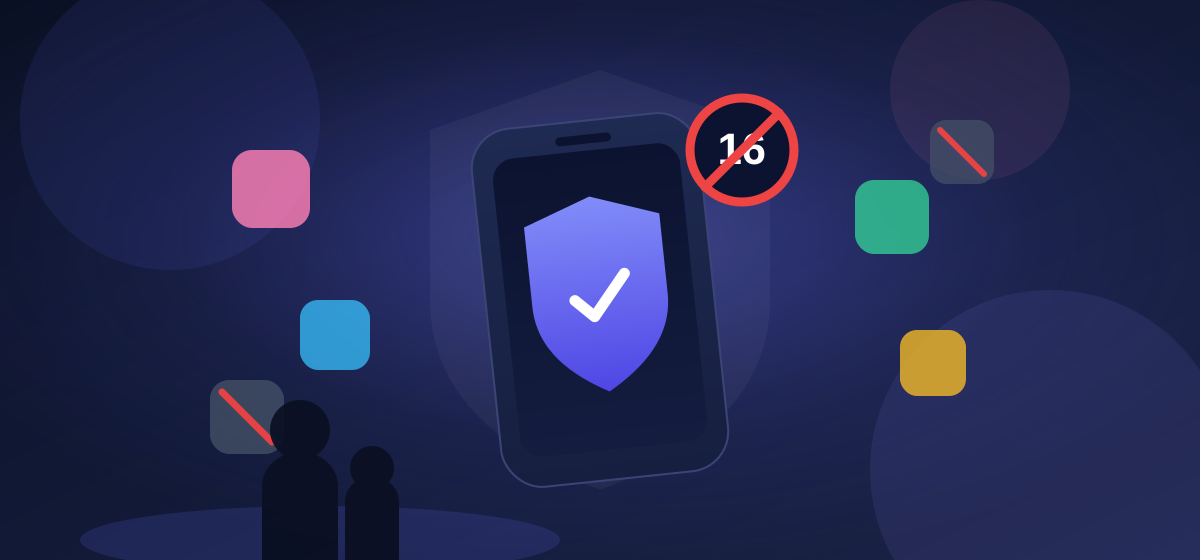
The UK Law in Detail
Under the announced measures:
- A complete ban for children under 16 on access to popular platforms (TikTok, Instagram, Snapchat, Facebook and others).
- For teenagers aged 16–17 — a daily screen-time limit (a ‘digital curfew’) and the disabling of the riskiest features (livestreaming, contact with strangers).
- Extension of the rules to AI chatbots: platforms are required to introduce age limits, especially on ‘romantic’ and intimate interactions, for users under 18.
The government cites the results of a public consultation in which ‘the overwhelming majority’, including many young people, supported the measures. Lisa Nandy stressed that this is not a ‘silver bullet’, but an important part of the strategy to protect children. The rollout is expected to be gradual, starting in 2027.
Why Does This Worry Parents Around the World?
In an era when children spend several hours a day on their smartphones, the risks are obvious:
- Addiction and mental health problems.
- Exposure to harmful content, bullying and exploitation.
- The influence of algorithms that promote negativity.
Britain is following Australia’s example, but going further by including artificial intelligence. Many families in Europe and the US are asking themselves: where will children actually be safer?
Moving to Russia: A Different Approach to Protecting Childhood
Russia has long had a comprehensive system for protecting minors online that combines government regulation, parental control and traditional values:
- Federal Law No. 436-FZ (‘On Protecting Children from Information Harmful to Their Health and Development’) strictly classifies content and blocks dangerous resources.
- Age ratings, a registry of banned sites, and mandatory identification on many services.
- Parental control systems in Russian messengers and platforms (VK, Telegram, Yandex services and others).
- Less aggressive algorithms than in the West, with an emphasis on education, sport and family values.
Unlike the United Kingdom, where blanket bans and age verification are being introduced (with risks to adults’ privacy), Russia focuses on prevention and family upbringing. Parents have more tools for direct control, and the state actively supports large families and programmes for children.

Advantages of Russia for Families with Children
Foreigners considering a move to Russia often note the following benefits specifically in the context of raising children:
- 1
A high level of real-world safety
Low levels of street crime in most regions compared with major European cities.
- 2
Affordable, quality education
A strong school curriculum, clubs and sports sections.
- 3
Government support for families
Maternity capital, allowances, benefits and housing-improvement programmes.
- 4
A healthier digital climate
Less pressure from ‘cancel culture’ and the hypersexualization typical of Western platforms.
- 5
Programmes for compatriots and specialists
A simplified path to a residence permit and citizenship for compatriots and qualified specialists.
Many families from Europe and the US are already relocating, choosing cities with a comfortable environment: Moscow, St. Petersburg, Krasnodar, Yekaterinburg, Novosibirsk, or quieter regions.
What to Do If You Are Planning to Move?
- 1
Explore the State Programme for the Resettlement of Compatriots (if you have roots) or other visa options.
- 2
Assess regions by quality of life, education and climate.
- 3
Prepare your documents and consult migration specialists.
- 4
Start with a trial visit — many people note that Russia is very different from the stereotypes in Western media.
Conclusion
The social media ban in the UK is a symptom of deeper problems in the Western digital space. While Europe introduces strict bans and grapples with questions of enforcement and privacy, Russia offers a balance between freedom, tradition and state protection.
Want more details about life in Russia, your children’s education, or specific immigration programmes? Write to us or get in touch with relocation specialists. Russia is open to families who value safety, education and their children’s future.
This article is based on official statements by the UK government and current Russian legislation as of June 2026.
Related articles


Ready to move to Russia? We guide you every step of the way
Guides, personal guidance and support for you, your family and your business.
relocated with us
0+38%