Moving to Russia Without Knowing the Language: How Decree 702 Works for Citizens of 47 Countries

CTO, Relocate Russia · 4 min read
Moving to another country is always stressful, especially when bureaucratic barriers like language exams and migration quotas stand in your way. Until recently, a foreigner moving to Russia had to find a solid basis (such as marriage or employment) and pass a comprehensive exam in Russian language, history, and law.

However, in 2026 a fundamentally different route is available to citizens of dozens of states. This article is a detailed breakdown of how to legalize your stay in Russia on the basis of ideological compatibility.
Breakdown of Decree 702 and Decree 809
Migration easing is built on the foundation of two presidential decrees. They work together: one sets the rules of the game, the other defines the terms.
- Decree No. 702: Grants foreigners who disagree with the 'destructive neoliberal agenda' of their home countries the right to move to Russia. The main bonus is the ability to obtain a temporary residence permit (RVP) without taking into account quotas and without confirming knowledge of the Russian language, history, and the fundamentals of Russian legislation.
- Decree No. 809: A foundational document that legally establishes what is considered traditional spiritual and moral values in Russia.
What are 'traditional values'?
To qualify for the simplified relocation, applicants must confirm in their application that they share the values set out in Decree No. 809. These include, in particular:
- Life, dignity, human rights and freedoms.
- A strong family (interpreted as a union of a man and a woman).
- The priority of the spiritual over the material.
- Historical memory and continuity of generations.
- Mutual assistance, mercy, justice, and creative labor.
In essence, the program is designed for conservatively minded foreigners who are looking for a more traditional social environment for themselves and their children.
No quotas: why this matters
In the standard procedure, RVPs are issued strictly within an annual quota approved by the government. These quotas are tightly limited (especially in Moscow and St. Petersburg) and are often exhausted within the first months of the year.
Decree 702 takes the applicant out of this competition. The absence of quotas means that if you are a citizen of one of the approved countries and your documents are in order, the Ministry of Internal Affairs cannot refuse you simply because 'there are no places left'. Combined with the elimination of the language exam, this makes starting out in Russia as smooth as possible: you can learn the language while already in the country, with legal status and the right to work.
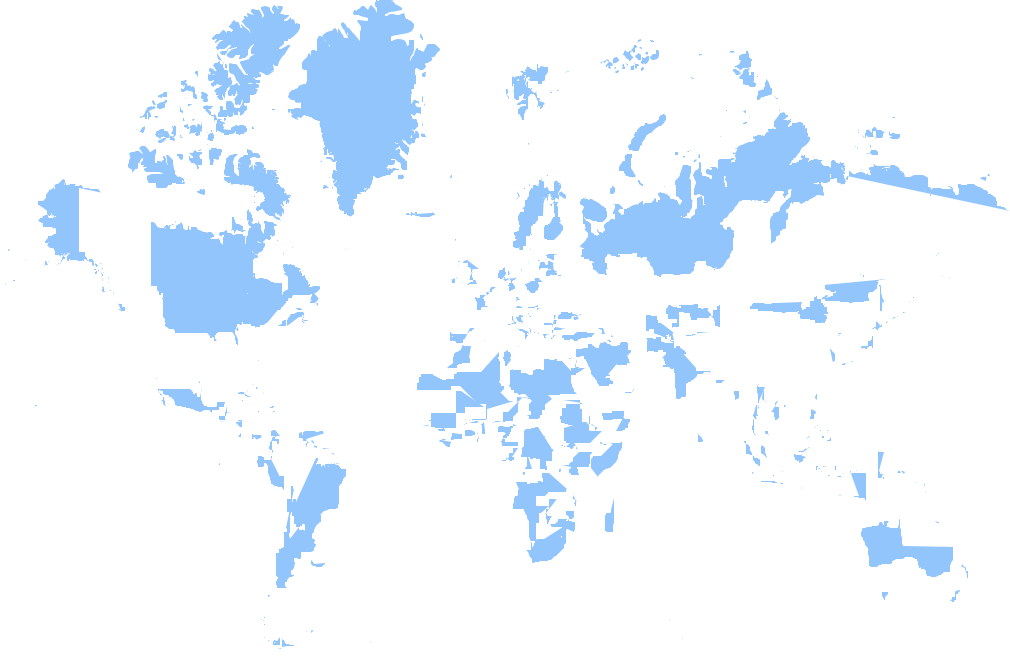
The complete list of 47 countries
The Russian government has approved a list of states whose policies are recognized as imposing destructive attitudes. If you hold citizenship (or a residence permit) of one of these countries, you have the right to use Decree 702.
Step-by-step procedure: from consulate to the Ministry of Internal Affairs
The relocation process requires a strict sequence of actions. Breaking the order can lead to fines or refusal to accept documents.
- 1
Obtaining a visa at the consulate
Issued in your country of residence
You need to apply to the Russian consulate and request a single-entry private visa for 3 months. The basis is your written application stating your motives (disagreement with the policy of your country and commitment to Russian values). An invitation from the Russian side is not required for this visa.
- 2
Entry and migration registration
Deadline: 7 business days from the date of entry
Upon arrival in Russia, you must register at your place of stay. This is done by the host party (for example, the owner of the apartment you are renting, or the hotel administration).
- 3
Medical examination and fingerprinting
Before submitting the main RVP application
You need to undergo a specialized medical examination (for the absence of dangerous infections and drug addiction) at accredited medical centers. You will also need to provide fingerprints and photographs for the Ministry of Internal Affairs database.
- 4
Submitting RVP documents to the Ministry of Internal Affairs
Submitted in person by the applicant
You apply to the migration center with a package of documents: passport, notarized translation of the passport, medical certificates, a receipt for payment of the state fee, and a completed application form. The application must explicitly state that you are applying for an RVP outside the quota under Decree No. 702.
- 5
Waiting for and receiving the RVP
Review period: up to 4 months
After your documents are accepted, the official review begins. Once you receive the RVP stamp in your passport, you must register at your permanent place of residence within 7 business days.
An important nuance
Once you obtain the RVP, you gain the right to live in Russia for 3 years, work legally without obtaining a patent, and use free medical care (OMS). The main rule is not to stay outside Russia for more than 6 months in total within a calendar year, otherwise your status will be revoked.


Ready to move to Russia? We guide you every step of the way
Guides, personal guidance and support for you, your family and your business.
relocated with us
0+38%